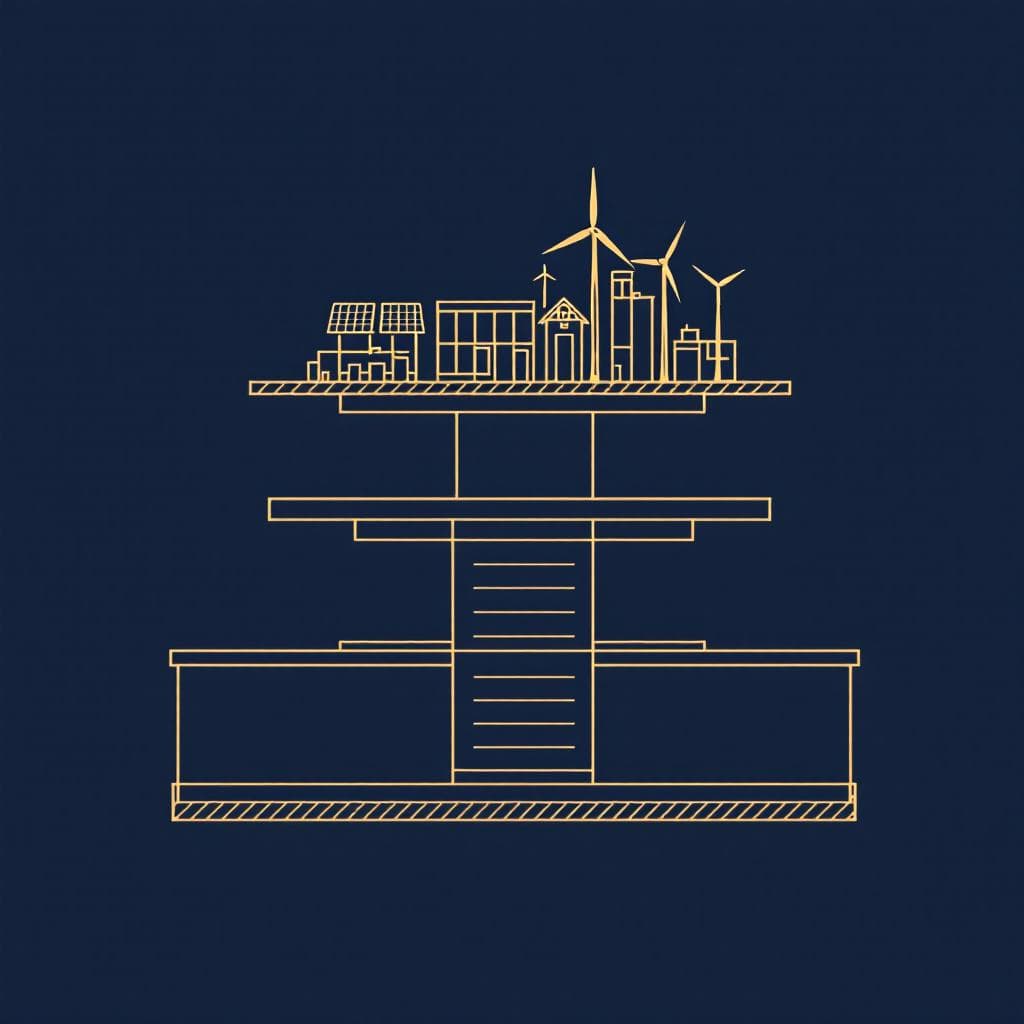
The financing problem of capital-intensive business models does not appear in any VC pitch deck. Series A and Series B are enough for product validation, initial rollout and team building. They are not enough to finance ten, twenty or a hundred megawatts of installed capacity per year, or to build a fermentation plant at industrial scale, or to commission an electrolysis facility. Not because investors are absent, but because VC logic and infrastructure financing logic describe two fundamentally different types of capital that cannot replace each other. This applies equally to cleantech, hydrogen, power-to-X and industrial biotechnology: wherever physical assets grow faster than equity alone can sustain. This article explains how both capital logics fit together, which layers become accessible when, what the process actually requires, and what is different in the DACH context compared to standard financing guides written for the US market.
The two balance sheets of a capital-intensive scale-up
Anyone building a business with physical assets effectively has two balance sheets. The first is the corporate balance sheet: headcount, sales, technology development, marketing. This side is financed with equity from VC rounds. That is the part investors are familiar with and for which valuation logic has been developed.
The second balance sheet does not exist in SaaS models: the asset base or project pipeline. Physical assets under construction or in operation, working capital from active contracts, pre-financed materials, warranty retentions, personnel pre-cost for projects that only pay on completion. This second side can grow faster than the VC equity base under aggressive growth.
A developer who has taken a first wind farm through the permitting phase and is now moving into construction faces a second balance sheet that is a multiple of the previous equity base: turbines, foundations, grid connection, ancillary construction costs. If this second side is financed with equity, the VC round is fully absorbed into project assets within a few months. The company has an asset but no capital left for permits, team and the next project pipeline.
This is not a theoretical problem. It is the most common bottleneck in capital-intensive scale-ups I work with. And it almost always stems from a conceptual mistake made early on: the belief that a single type of capital can finance both balance sheets at once.
To identify which dimension is currently limiting your growth most: Structure First Bottleneck Index.
Which business models have this problem?
The two-balance-sheet problem is not specific to cleantech. It affects every business model where physical assets grow faster than the equity base. In DACH, this constellation is concentrated in four areas:
- Renewable energy (wind, utility-scale solar, commercial charging infrastructure): Wind farms, large ground-mounted photovoltaic plants and public fast-charging networks are classic project finance candidates: secured revenues through feed-in agreements or long-term usage contracts, asset-backed cash flows, Special Purpose Vehicle (SPV) structures. For developers building several projects in parallel, the two-balance-sheet question is particularly acute: permitting costs, equity contributions and pre-financing for multiple SPVs simultaneously bind more capital than a single VC round can carry.
- Hydrogen and power-to-X (electrolysers, e-fuels, green ammonia): Electrolysers and synthesis plants are capital-intensive individual assets with secured offtake structures: classic project finance territory. The first-of-a-kind premium (FOAK) is often higher here than for established renewable energy projects, because bank precedents are still missing. Venture debt from the European Investment Bank (EIB) has established itself as the central instrument for this phase.
- Industrial biotechnology and food tech: Bioreactors and fermentation plants follow the same capital logic as project assets: high initial investment, long-term cash flows, bankability built through operating history. The difference lies in securing the revenue side. Offtake agreements in the food sector are harder to lock in than feed-in tariffs, which pushes the bankability curve back.
- Circular economy and industrial bioeconomy: Pyrolysis plants, biogas platforms and recycling systems with secured offtake streams are classic project finance candidates. The financing structure differs little from renewable energy projects. What matters is secured input and output streams and a robust technical concept.
The common denominator: a business model where revenue only flows once the plant is running, and where the plant costs more than VC equity alone can often cover. Whoever recognises this pattern will find the relevant financing logic here.
Capital stack: understanding layers rather than looking for individual instruments
The most common thinking error in scale-up financing: the search for the right instrument. What actually matters is a capital stack, meaning several financing layers with different risk and return profiles that build on each other.
At the top of the stack sits equity: the most expensive capital, because equity providers bear the highest risk and are paid last. Below that comes mezzanine, a hybrid layer between equity and classic bank debt that carries more risk than senior debt and is priced accordingly higher. One layer below that sits senior secured debt, meaning secured, priority-ranking debt at the bottom of the stack and therefore the cheapest layer. Senior debt providers impose the strictest requirements, but are willing to finance at lower rates because they are paid first in an insolvency.
Stack design means: which layer finances which part of the business, in which sequence, and at what price? A common mistake is mixing up layers. Financing project assets with equity means paying the most expensive capital rate for assets that could be financed more cheaply through debt. Trying to finance technology development with bank loans fails because the lender needs cash flow certainty that early-stage development work cannot provide.
Bankability: not a switch but a spectrum
A project or company is bankable when its risk profile meets the internal requirements of a debt provider. Bankability is not binary. It is a spectrum that shifts with each completed project, each signed offtake agreement and each year of demonstrated operating history.
What lenders actually assess can be reduced to seven core questions. The first six are standard criteria; the seventh is asked more explicitly by debt funds than by banks:
- 1Is the technology proven and suitable for the planned scale? Prototypes and pilot plants are not enough. Lenders want reference projects at comparable scale and first credible operating data in commercial deployment.
- 2Are there contractually secured revenues? Feed-in agreements, offtake contracts or long-term service agreements with creditworthy counterparties are the foundation for any cash flow plan. Unsecured revenues are not a viable basis for classic project finance.
- 3Has the sponsor, meaning the company that develops the project and is responsible to the lender, successfully completed and operated similar projects? Track record means not just construction but also years of operation. A first-time sponsor pays the FOAK premium and faces a significantly narrower lender market.
- 4Is the project construction-ready and fully permitted? Missing or contestable permits are a knockout criterion. Lenders finance only once regulatory risk has closed, not during open appeal or litigation proceedings.
- 5Does the financial model hold under stress scenarios? Lenders systematically test cost overruns, construction delays and revenue shortfalls. Projects whose Debt Service Coverage Ratio (DSCR) is already near the minimum threshold under base assumptions are rejected.
- 6Is the security package fully structured? This includes assignment of all project contracts, account pledges, mortgages, share pledge over the SPV and direct agreements with all key counterparties. Incomplete security can block an otherwise bankable deal.
- 7Can the plant be operated by an independent party if the sponsor fails? Debt funds ask this question more explicitly than banks, because they finance non-recourse: in a distress scenario they have no recourse to the sponsor's assets, only to the project and its running operations.
The specific problem for capital-intensive scale-ups in early phases: they have often answered the first question, because without proof of technology no VC round would be possible. But questions three, four and five are structurally hard to answer for a FOAK project. Lenders want precedents. For the first project there are none.
The practical consequence for contract structure: debt funds frequently require an independent Operations-and-Maintenance contract (O&M) with a certified third-party operator, manufacturer maintenance agreements with defined escalation paths and complete technical documentation as a handover obligation. The goal is to ensure the plant can be taken over in an emergency without relying on the founding team's knowledge.
Related to this is an instrument that rarely comes up in founder conversations: direct agreements with all key counterparties. These are separate agreements between the lender and the offtake buyer, the Engineering, Procurement and Construction contractor (EPC, meaning the general contractor for design, procurement and construction), the O&M operator and the grid operator. They give the lender the right to step directly into the project contract structure if the sponsor fails, and simultaneously prevent the counterparty from terminating their contract without a prior cure period.
Without direct agreements, project contracts can terminate uncontrollably in the event of an SPV insolvency. With them, the project survives as a going concern, and the lender can either step in directly or appoint a substitute entity to take over operations. This step-in mechanic is the core of the non-recourse security package and the reason why debt funds are significantly more demanding in their contract work than classic bank loans.
Bankability is built across several projects, not in one step. The first project runs with a higher equity share and more expensive debt conditions. The second project is cheaper because the sponsor now has a track record. By the third or fourth project, the broader bank market opens up with standard conditions.
Banks versus debt funds: the cost logic
Banks are structurally cheaper debt providers than debt funds, and the reason is straightforward: banks refinance themselves through deposits on which they pay minimal interest. Debt funds refinance through institutional capital from pension funds, insurance companies and family offices. That costs more, and this cost premium is passed on to the borrower.
But banks cannot always lend, even when they want to. They are subject to regulatory requirements that determine which risks they are permitted to take. For unknown technology, a missing sponsor track record or unsecured revenue streams, many projects do not fit their credit guidelines. This is not risk aversion in a narrow sense but a regulatory framework.
Debt funds operate outside this regulation. No deposit insurance obligations, no minimum equity ratios at the loan level. That gives them more flexibility on risk structure, terms and contract design. And speed: while a bank credit committee may take weeks or months, many debt funds decide faster.
Three debt fund types serve different phases of the project lifecycle:
- Short-term construction and bridge funds: finance the construction phase at higher rates, take construction risk, typical tenor two to five years. Classic bridge function, refinanced after operations begin.
- Long-term infrastructure debt funds: hold projects ten to twenty years, buy operational assets with stable cash flows, and compete directly with banks in the long-term phase. Motivation: liability matching for pension funds and insurance companies. These funds are not a bridge instrument but a standalone end-capital provider.
- Unitranche funds: finance construction and operations in a single instrument without refinancing. More expensive than a pure bank loan, but one counterparty across the entire project lifecycle.
For capital-intensive scale-ups in early phases: the first financing partner is almost never a classic commercial bank, but a specialised fund or development institution that accepts higher risks. As the track record grows, the market shifts. From two to three completed and operational projects, the banking sector increasingly opens up and cost of capital falls.
The financing process: what to expect
Early project financings at scale-ups do not run through a house bank that approves a loan. They run through specialised debt funds, development institutions or the EIB, and the process is fundamentally different from a classic credit conversation. From the first structured lender approach to financial close, well-prepared projects take six to twelve months; FOAK projects or complex structures take twelve to eighteen months. Underestimating this leads to negotiating under time pressure and accepting terms that more lead time would have avoided.
The five phases in overview:
- 1Project preparation (three to six months before first lender contact): The sponsor prepares the complete project package independently before approaching lenders: permitting status, secured offtake agreements or feed-in tariffs, completed technical concept, credible financial model. Experienced sponsors additionally commission their own technical assessment and legal review of the project to accelerate the subsequent lender due diligence and avoid surprises. Going into first conversations without a complete package signals poor preparation, in a relationship where the lender will later look closely into every corner of the project.
- 2Competitive lender selection (one to two months): The sponsor approaches three to five specialised debt funds or development institutions in parallel, not sequentially. Competitive pressure is the decisive lever: approaching only one lender means negotiating without an alternative. Based on indicative term sheets (Indications of Interest), one to two candidates are selected for the full due diligence. An early formal exclusivity mandate is unusual for early-stage scale-up projects. Exclusivity arises in practice only on entry into the full DD.
- 3Due diligence (two to four months): The lender appoints an independent technical advisor (Lender's Technical Advisor) and a legal counsel at the sponsor's cost, and reviews the financial model. Experienced sponsors additionally commission their own technical advisor (Owner's Engineer) who asks the same questions the lender will ask, in order to identify weaknesses before the formal DD begins. This materially shortens the subsequent lender DD. With EIB involvement the process is significantly broader and longer: the EIB additionally reviews economic, social and climate-related aspects as well as sponsor capacity, and the appraisal phase alone can take between six weeks and eighteen months.
- 4Term sheet and credit approval (one to two months): The lender issues a binding term sheet. The sponsor negotiates terms, covenants and security structure before the lender's internal credit committee decides. Anyone who built competitive tension in the lender selection phase negotiates here with better cards.
- 5Financial close (two to four months): Credit agreement, security agreements, direct agreements with all key counterparties and all project documents are negotiated and signed. In parallel, conditions precedent must be satisfied: all permits confirmed, project contracts fully executed, insurance structure evidenced, account structure established, share pledges registered in the commercial register, legal opinions from all relevant jurisdictions delivered. Only once all CPs are met does the first capital drawdown occur. In practice, this phase is the most common source of delays: a single missing document or open registration position can push the entire close back by weeks. Good preparation in phase one pays off directly here.
The central metric against which lenders measure every project is the DSCR: project cash flow divided by annual debt service. The minimum requirement is typically between 1.1x and 1.3x for established technologies, and between 1.3x and 1.5x for technology-exposed or early projects. Specialised debt funds do not necessarily accept lower DSCR thresholds than classic banks. Higher risk is generally compensated through pricing, not through a lower DSCR. This ratio directly determines how much debt a project can carry and at what terms.
After financial close, all project revenues flow into a collection account that is paid out in a defined sequence. Operating costs and taxes first, then debt service, then a top-up of the debt service reserve account as buffer, then capital reserves, and only then distributions to the sponsor. This waterfall structure protects the lender and disciplines cash management.
When the debt market opens up
Four stages determine which instruments become accessible:
Stage 0: Before first revenue
No debt market. The only path to external capital runs through equity, public grant programmes and, at European level, instruments such as the EIC Accelerator. This layer is designed for technology development and product validation, not project finance.
Stage 1: First revenue and completed small projects
Revolving working capital lines open up once the company can show measurable revenue history and collateral. Beyond classic credit lines, two further instruments are available: factoring unlocks liquidity against existing receivables, where the creditworthiness of the debtor, meaning the end customer, is what matters, not that of the scale-up itself. Payment terms with suppliers are not an arranged financing instrument, but a relevant cash management lever that reduces liquidity requirements. In Germany, KfW programmes such as the ERP Start-up Loan Universal (up to EUR 25m) are often the only route to affordable working capital credit for young companies without extensive collateral. Volumes are limited and terms are conservative, but the debt build-up begins. For bank- and KfW-based instruments, a functioning house bank relationship is a prerequisite in Germany, discussed further below.
Stage 2: First project operational
An operationally running project has measurable cash flows and no more construction risk premium. From here, refinancing the construction project from expensive bridge capital to cheaper long-term structures becomes possible. The first sponsor track record exists. Lenders can look at actual numbers rather than projections. Companies that have not yet built systematic project controlling at this stage are missing the foundation for any credible financial model and for the ongoing reporting to lenders and investors.
Stage 3: Two to three completed projects
Sponsor track record is established. Banks can point to comparable projects. Credit conditions improve. First SPV financings as genuine limited-recourse structures become possible: recourse to the holding is limited to defined events such as construction completion failure, rather than burdening the entire holding balance sheet. Full waiver of any sponsor support remains the exception even for experienced sponsors. Access to a broader range of lenders opens up, and portfolio credit facilities become possible: a bank provides a revolving credit line against multiple projects as a combined security package, which materially improves financing efficiency as the project pipeline grows.
Outlook: beyond the scale-up stage
With an established track record and a growing project pipeline, instruments open up that go well beyond classic project finance. Institutional infrastructure investors, such as pension funds and insurance companies, acquire completed project portfolios and thereby recycle the sponsor's equity for new projects. Green bonds and corporate bonds enable direct capital market access without bank intermediation. Syndicated credit facilities replace bilateral bank relationships. These instruments are not yet an operational topic for early scale-ups, but they define the target architecture: a financing structure oriented towards this level from the start avoids costly restructuring later.
DACH specifics: the house bank principle and public financing
In the DACH context there are two structural features that do not appear in US or UK financing guides.
The house bank principle
KfW subsidised loans in Germany are not issued directly. Every application runs through the company's house bank (Durchleitungsprinzip). The house bank takes on part of the risk, reviews the application independently and decides whether to forward it to KfW. If the house bank does not understand the business model or is unwilling to take the risk, there is no KfW loan, regardless of how solid the project is.
For capital-intensive scale-ups this has a clear practical consequence. The house bank relationship is not a soft task to be built at some point. It is a structural prerequisite for access to classic KfW programmes. Exceptions exist: newer KfW programmes such as the Venture Tech Growth Financing (VTGF) operate without house bank intermediation and offer direct KfW access specifically for tech scale-ups. For the majority of KfW programmes, the intermediation principle continues to apply.
Public financing as a distinct layer in the capital stack
In the DACH region, public financing is not a fallback for companies without market access. It is a distinct layer in the capital stack with conditions unavailable in the open market. KfW programmes for renewable energy and sustainable investments often offer subsidised interest rates and more favourable tenors than pure bank financing.
The catch is the process: KfW applications must be submitted before the project begins, coordination with the house bank takes several weeks to months depending on programme complexity, and strict use-of-proceeds reporting obligations accompany the entire term. Founders who understand the system early and apply in time can mobilise several million euros at conditions not otherwise available. Applying when the cash squeeze has already arrived is too late.
A further DACH specific: the private debt market in Germany is structurally less developed than in the UK or the US. Classic bank loans play a smaller role for startups and early scale-ups than in other markets, and venture debt played almost no role in Germany for a long time. That is changing, but more slowly than elsewhere. For founders this means: the DACH market offers fewer early-stage options than US experience reports would suggest.
EIB Venture Debt: the European complement
Alongside KfW, the EIB is the most important single debt provider for capital-intensive deep-tech and cleantech scale-ups in Germany. The EIB provides venture debt typically between EUR 10m and EUR 50m directly to growth companies: no house bank principle, no intermediation, a direct credit relationship. The prerequisite is demonstrated technology in a commercial or advanced development phase and an investment plan within the EU.
The EIB's sector focus aligns with the business models described in this article: cleantech (energy transition, decarbonisation, circular economy), deep tech (advanced manufacturing, sustainable production) and life sciences. EIB terms are generally more favourable than those of private debt funds and more flexibly structured than classic bank loans. The downside: process times are longer, documentation requirements are higher, and a compelling technology and growth story is a prerequisite. EIB venture debt is not a substitute for KfW but a complement: primarily for transactions that exceed typical KfW programme volumes, or for technologies that have no bank precedent yet.
Common mistakes in financing planning
Four mistakes repeat themselves systematically:
Starting too late
Working capital lines, mezzanine structures, SPV setups and KfW applications need six to eighteen months of lead time. Starting only when liquidity is tight means negotiating under pressure. Terms accepted under pressure tend to cost again at the next refinancing. The financing roadmap of a capital-intensive scale-up is a three-year strategy, not a reaction to the next squeeze.
Financing working capital with equity
This is the silent capital destroyer. Material pre-financing, supplier advance payments, warranty retentions, personnel pre-cost: none of this is investment in the company, it is operating capital. It should be financed through revolving credit facilities or specific asset-backed structures, not equity. Failing to separate this early burns VC equity on operating capital without improving the substance of the business.
No financing language in the team
Project finance has its own language: DSCR, waterfall, financial close, conditions precedent, non-recourse, mezzanine. Not knowing these concepts puts a team at a structural disadvantage in lender conversations: it is about being able to negotiate term sheet conditions, anticipate due diligence requirements and credibly signal to lenders that the team understands the business. Founders who have a CFO on board should anchor this language there: the CFO leads the process, negotiates term sheets, coordinates due diligence and manages lender relationships. What the founder needs to understand personally are the conceptual decisions: which layer for which purpose, when an SPV makes sense, how bankability connects to product progress. Founders without a CFO yet will find a decision framework in the article on when to make the first CFO hire. Many scale-ups recognise this need too late, which leads to a rushed hire for a CFO with a project finance background at a moment when pressure is already high.
Treating first terms as permanent
The first debt terms a young capital-intensive company receives are almost always expensive. That is not an anomaly but market logic: no operating history means a risk premium. Experience shows that most debt structures can be refinanced at materially better terms after twelve to thirty months once the portfolio has built a demonstrable repayment history (seasoning). The first financing deal is the entry into a lender relationship, not the final state.
Where to start if the build-out has not begun
Anyone who has not yet built any of the structures described faces a concrete question: what first? The answer depends on the current stage. Before the first completed project, the most important investment is not a financing structure but the house bank relationship and a first credible financial model for the project. Both cost little but create the prerequisites for everything that follows. Anyone who has already completed a first project should now pursue three things in parallel: build systematic project controlling that delivers operational actuals, review whether that project can be refinanced at better terms, and start building the working capital lines the next project will need. Without operational data from the running project, the foundation for refinancing and working capital build-up is missing. The most common reason for inaction is the expectation of needing to understand everything before holding the first conversation. That is wrong. The first conversation with a house bank or a specialised lender is itself a learning step.
Conclusion
Capital-intensive scale-ups rarely fail because of the technology. They fail because two fundamentally different capital logics have to work together in one structure, and because one logic requires time that the other does not plan for. VC equity is designed for building a company. Project finance is designed for assets with demonstrable cash flows. Anyone trying to force both into a single instrument gets neither right. The only path is deliberate separation: two balance sheets, two capital sources, two processes run in parallel from the start.